Field Note: Five words for the same thing
At the moment there are no fewer than five phrases going round that all describe the same work, and if you’re trying to work out which one to learn first, I have good news.
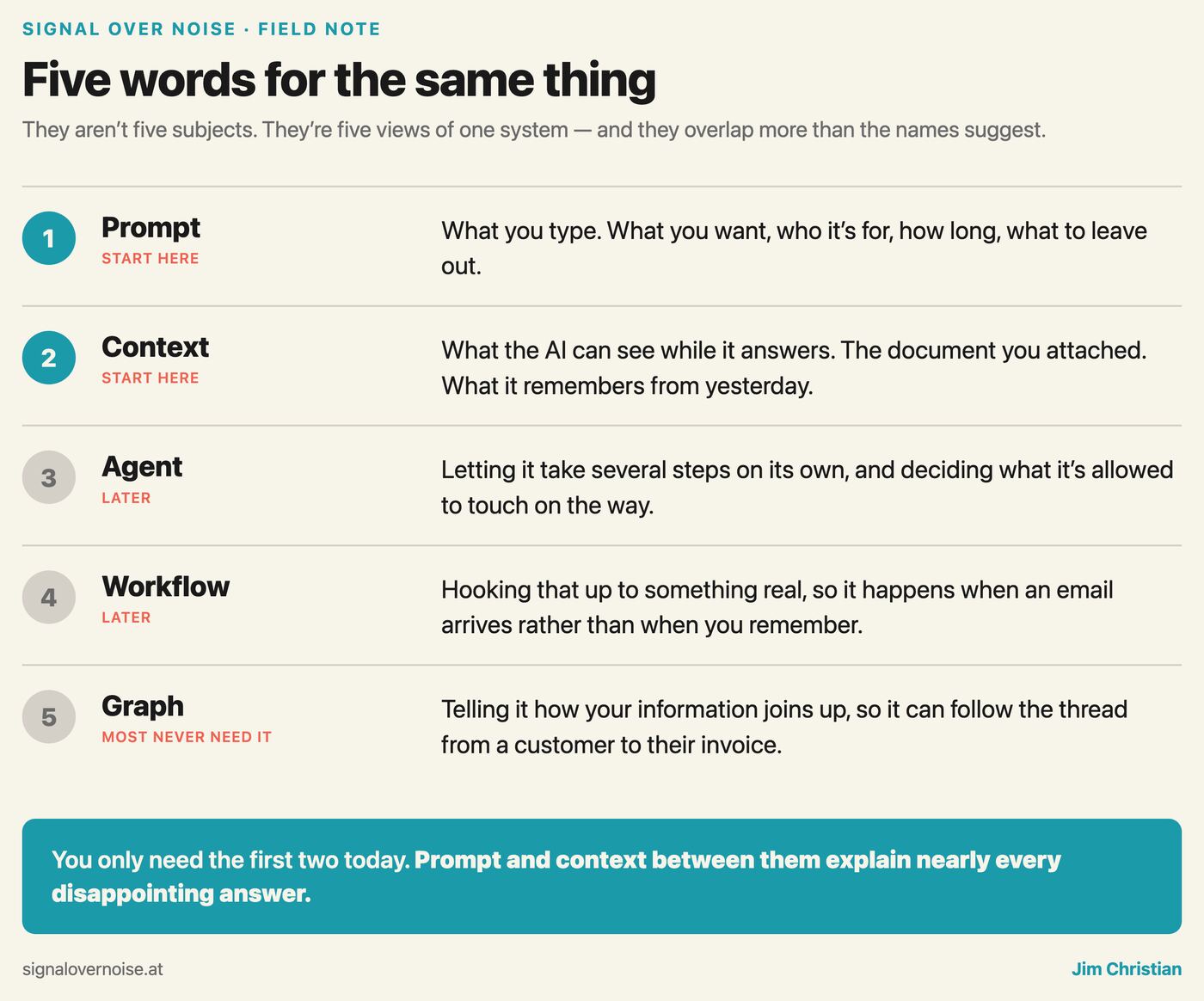
The phrases are: - Prompt engineering - Context engineering - Agent engineering - Workflow engineering - Graph engineering
They aren’t five subjects. Rather, they’re five views of the same system, and they overlap more than the names suggest:
Prompt engineering is what you type. What you want, who it’s for, how long, what to leave out.
Context engineering is what the AI can see while it answers. The document you attached. What it remembers from yesterday. Whether it can look at your calendar. Whether it’s allowed to.
Agent engineering is letting it take several steps on its own instead of one, and deciding what it’s allowed to touch on the way.
Workflow engineering is hooking that up to something real, so it happens when an email arrives rather than when you remember.
Graph engineering is telling it how your information joins up, so that when it looks something up it can follow the thread from a customer to their invoice to the complaint they made in March.
That’s the whole thing. Five names for parts of one job, and in practice they blur into each other.
Why it keeps changing
Because the products changed and the words ran to catch up.
Two years ago you typed into a chatbot box and got words back. “Prompt engineering” was basic enough to cover that. Then the AI could open your files, remember things, search the web and press buttons on your behalf, so the stuff you were typing up stopped being the main event. “Context engineering” is what people started calling the bigger job of deciding what it gets to see before it answers.
While the names keep moving, the skill underneath has barely shifted: say what you want, give it what it needs, and when it works, stop doing it by hand.
Where to glom on
Start with the smallest thing that teaches you the most. Take one job you do most weeks. Write the instruction as if you were briefing a new starter, and paste in one real example of what a good result looks like. That’s it. That’s prompt and context, the only two words you need today, and between them they fix most of what goes wrong.
When it does go wrong, the vocabulary tells you where to look first:
- Wrong length, wrong tone, wrong shape → start with the prompt.
- Confident and wrong about your business → start with context. It probably didn’t have the facts.
- It works, but you’re pasting the same thing in every morning → that’s a workflow question.
- Fine on one step, falls apart across three → that’s the agent end.
- Keeps missing things it should have joined up → graph, and most people never need to go there.
Now, those are starting points, not necessarily diagnoses. More than one can be true at once. For most people prompt and context between them explain nearly every disappointing answer, so you can leave the rest alone until something forces you.
Also this week
Security
Someone planted about 800 fake AI add-ons where people go looking for them, and the assistants recommended them.
Two bits of vocabulary first, because the story doesn’t work without them. A Skill is a set of instructions you give an AI assistant to teach it a particular job. An MCP server is a small piece of software that lets an assistant reach something else you use — your email, your files, your calendar. You install both of these roughly the way you’d install a phone app, and usually because something or someone recommended it.
Security firm Island found roughly 7,600 booby-trapped projects published on GitHub, the site where most of the world’s shared software lives. More than 800 of them were dressed up as Skills or connectors, and they turned up over 600 times in the public directories people browse to find such things. The trap is a download. The instructions tell you to fetch a file and run it, and running it quietly installs something that takes your saved passwords and the sessions you’re already logged into. Island’s report has the detail, and it was covered independently by The Hacker News and Help Net Security.
Island asked Claude Code, Gemini and ChatGPT to find a free connector for Walmart. All three found a poisoned one on their own, without being sent a link, and two of them recommended it as the best place to start.
Your assistant does the looking-up for you here, and gets it wrong in a way that looks exactly like getting it right. There’s no dodgy link in an email to learn to distrust.
If you install this sort of thing, one habit is worth forming: get it from someone you already have reason to trust, rather than from whichever result came back first. The description on the page proves nothing — the people who set the trap wrote it.
Models
Alibaba unveiled Qwen3.8-Max, its newest AI system, and says it can write and fix software on its own for weeks at a time with barely any human involvement. It’s a preview for now, running only on Alibaba’s own services, with a wider release promised.
The “weeks” claim is the one that needs checking by somebody other than Alibaba. Answering one question well is a solved problem. Staying useful across a long job without wandering off is not, and a demo is the worst possible way to check it. Alibaba has published its own comparisons but not much else yet. If you leave AI running on jobs while you do something else, wait for someone independent to test it before you believe the number. Otherwise this changes nothing for you this week.
Tools
Grok, the chatbot built by Elon Musk’s xAI, added a Build mode that turns a written description into a working web page or small app you can share with people. No verdict from me, but one caveat: it’s only available on the most expensive plan, so “anyone can build software now” is doing a lot of work in the coverage. The gap between describing software and having software keeps narrowing, whoever happens to narrow it.
Generative AI
Google launched Lyria 3.5, which writes and performs a whole song from a description, inside its Flow Music tool. The vocals and lyrics are better than the last version.
Google says it trained this on music it holds the rights to, while its two main rivals, Suno and Udio, are being sued by Sony Music over the songs their systems learned from. If you ever plan to put AI-generated music in something you sell, that difference is worth more of your attention than whose vocals sound better this month. It lowers the risk in the training data. It doesn’t settle every question about what you’re then allowed to do with the output.
— Jim