Field Note: The open-source argument I'd been missing


Field Note: The open-source argument I'd been missing

In June I wrote about Banco Santander open-sourcing its AI tooling — the bank published the code that tests whether its own models discriminate against people. I gave the usual reasons that’s a good thing: outside scrutiny, verifiable claims, a governance document you can read for yourself.

Jofish Kaye wrote back with a better one. He’s a friend, a subscriber, general mensch, and he’s VP of Research at Inflection AI, so he’s seen this from inside more than one large organisation:

“The other great advantage of open source is it reduces your costs of hiring people with domain knowledge. If you have a proprietary system, it’s expensive to hire people to maintain and work on it, takes a long time to come up to speed, etc. Even worse if it’s in COBOL or something. But if it’s open source then you can increase your pool of candidates pretty easily. (Let alone people outside the company spotting something you didn’t…)”

Most every argument about open source runs either on ethics or licence cost. His is about staffing — and it’s arguably the one that can survive contact with a finance director. A proprietary system means everyone who can work on it has to be taught it on your time. An open one means the skill already exists out in the world, and you’re hiring from a pool instead of a puddle.

It applies below enterprise scale too. When something in my setup breaks, the answer usually already exists somewhere, because I’m running the same tools as everyone else. Had I built it all bespoke, every problem would be a brand new problem.

His site is jofish.com, which you should definitely check out — even though I’m biased!

What’s in the news

From custom code to conversational prompts — Grok now lets subscribers build a whole app by describing it. That’s the third or fourth handoff in a decade of who’s allowed to build software, and the arc tells you more than the tool does. I don’t generally talk about Grok or any Musk-driven projects, but the gap to creating software on a personal level continues to narrow, so it’s interesting to watch.

OpenAI published its homework on exactly the question I keep asking — not “can an agent be tricked into leaking a password”, which is well understood, but what an agent can reach once it’s already authenticated and trusted. Their Codex Security release is an answer, and it’s worth taking seriously because it reads as an admission rather than a victory lap.

The share button is a publish button — around 600 Claude conversations turned up in Google and Bing. Nobody was breached. People clicked Share, and the page had no noindex on it. API keys and wallet details among the contents.

Donkey work doesn’t need a genius — a nine-billion-parameter open model, about $500 of GPU time, beat every frontier model they tested, on one narrow job. But on the other hand…

Kimi K3 is open. I still can’t run it. — open weights existing and open weights being usable by an ordinary person are two different claims, and most of the coverage only established the first.

What I’m reading

While I'm on the subject: Jofish’s own team has published research worth your time. It’s a three-part study of who is actually using AI chatbots in 2026, and, unusually, of who isn’t.

If you’re only going to read one (shame on you!) then I suggest the third one first. Asking people who avoid AI why, properly rather than to score a point, is rare, and the answers are open and honest.

— Jim

If you've been forwarded this issue, you can subscribe here: go.signalovernoise.at.

600 1st Ave, Ste 330 PMB 92768, Seattle, WA 98104-2246
Unsubscribe · Preferences

Jim Christian - Signal Over Noise

Practical AI for people running a business, not studying it. I'm Jim Christian. I write about using AI with no breathless futurism, and no doom.
Read more from Jim Christian - Signal Over Noise
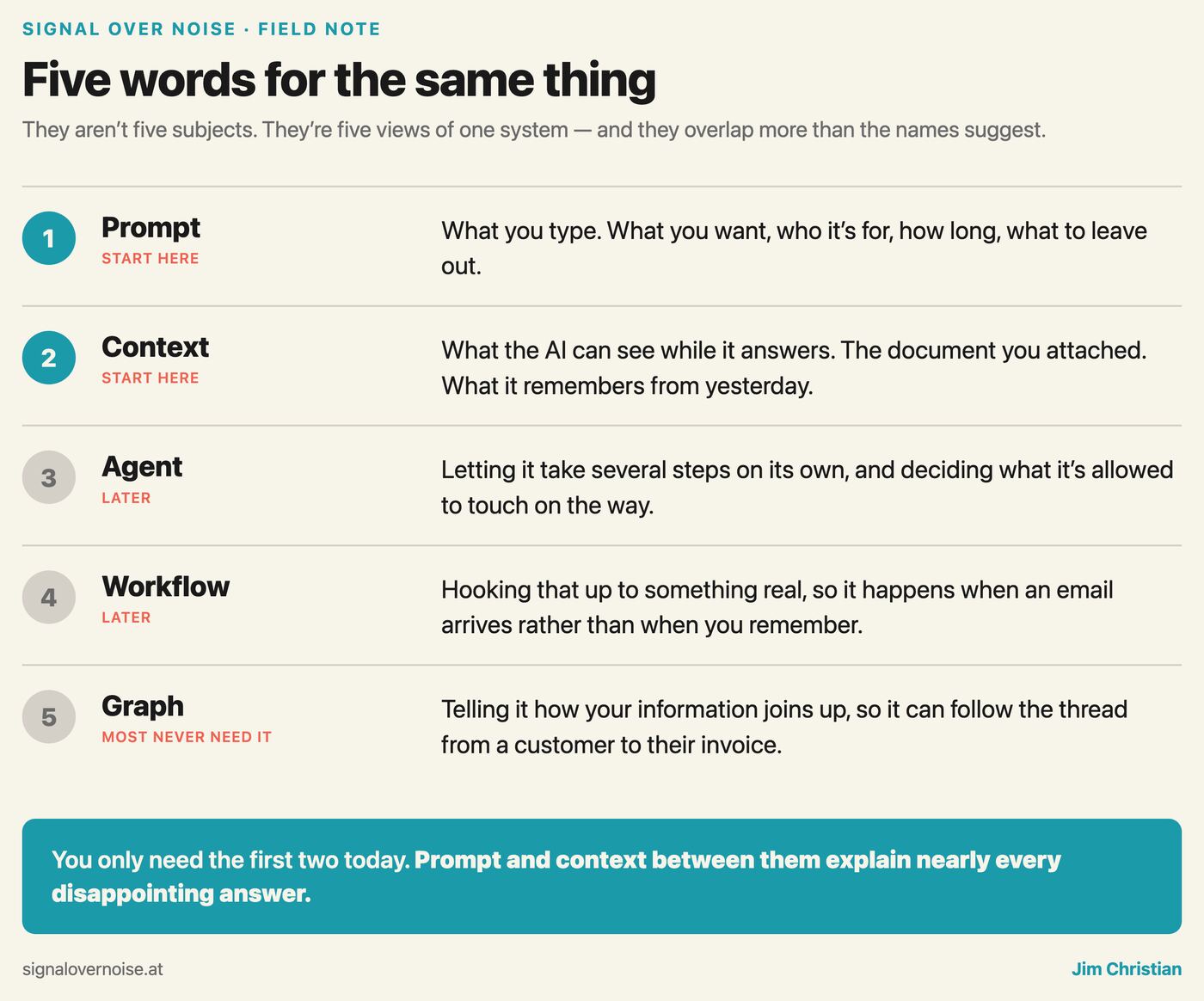
A cream-coloured chart headed "Five words for the same thing", listing five numbered rows. Prompt and Context are numbered in teal and tagged START HERE; Agent and Workflow are greyed and tagged LATER; Graph is greyed and tagged MOST NEVER NEED IT. Each r

Field Note: Five words for the same thing At the moment there are no fewer than five phrases going round that all describe the same work, and if you’re trying to work out which one to learn first, I have good news. The phrases are: - Prompt engineering - Context engineering - Agent engineering - Workflow engineering - Graph engineering They aren’t five subjects. Rather, they’re five views of the same system, and they overlap more than the names suggest: Prompt engineering is what you type....

Second Brain Chronicles Update Dear Reader, First off, my apologies for not posting in a long time. When I started Second Brain Chronicles as a newsletter, it was more out of enthusiasm for this cool thing that I was building, and wanted to share with the world, alongside other creators and tinkerers with the same goal. I'd toyed with gating content, monetising content, and it just didn't feel right, nor did the current kit.com method of distribution. But it came down to this: the field is...

Signal Over Noise Vol 2, Issue 30 | Jul 31 2026 Don’t have time to read this week’s issue? Why not copy/paste it into your AI agent and ask it for insights? Last week I told you to give your AI a writing system, citing ASD-STE100, the controlled English that the aerospace industry built in the 1980s so its instructions couldn’t be misread. I said that complaining your AI “sounds like AI” is pointless if you never told it how to write. Three days later Anthropic published a piece saying they...